
Leveraging Facial Recognition for Secure Visitor Access: The Future of Check-Ins
There is a scene that plays out thousands of times a day at enterprise facilities across India. A visitor arrives at the gate, presents a physical ID, waits while a security guard manually verifies it, signs a register, receives a printed badge, and is then escorted or directed to their destination. The entire process takes anywhere from five to fifteen minutes — and at no point does anyone truly verify that the person standing at the desk is actually who they claim to be.
This is the fundamental flaw in traditional visitor check-in: it is built on documents, not identity. Facial recognition technology, integrated into a capable visitor management system, changes this equation fundamentally. It moves visitor verification from document-based to identity-based, from manual to automated, and from reactive to proactive.
1. What Facial Recognition in a Visitor Management System Actually Does
In a well-implemented visitor management system, facial recognition works at two stages. The first is during pre-registration or initial check-in, where the visitor’s photograph is captured and linked to their profile in the system. The second is at every subsequent entry point, where the system compares the live camera feed against the stored profile to verify that the person presenting themselves is the same individual who was registered and approved.
Modern facial recognition engines use biometric mapping — measuring the geometry of facial features — to make verification decisions with a high degree of accuracy, even accounting for variations in lighting, angle, and the use of masks or glasses.
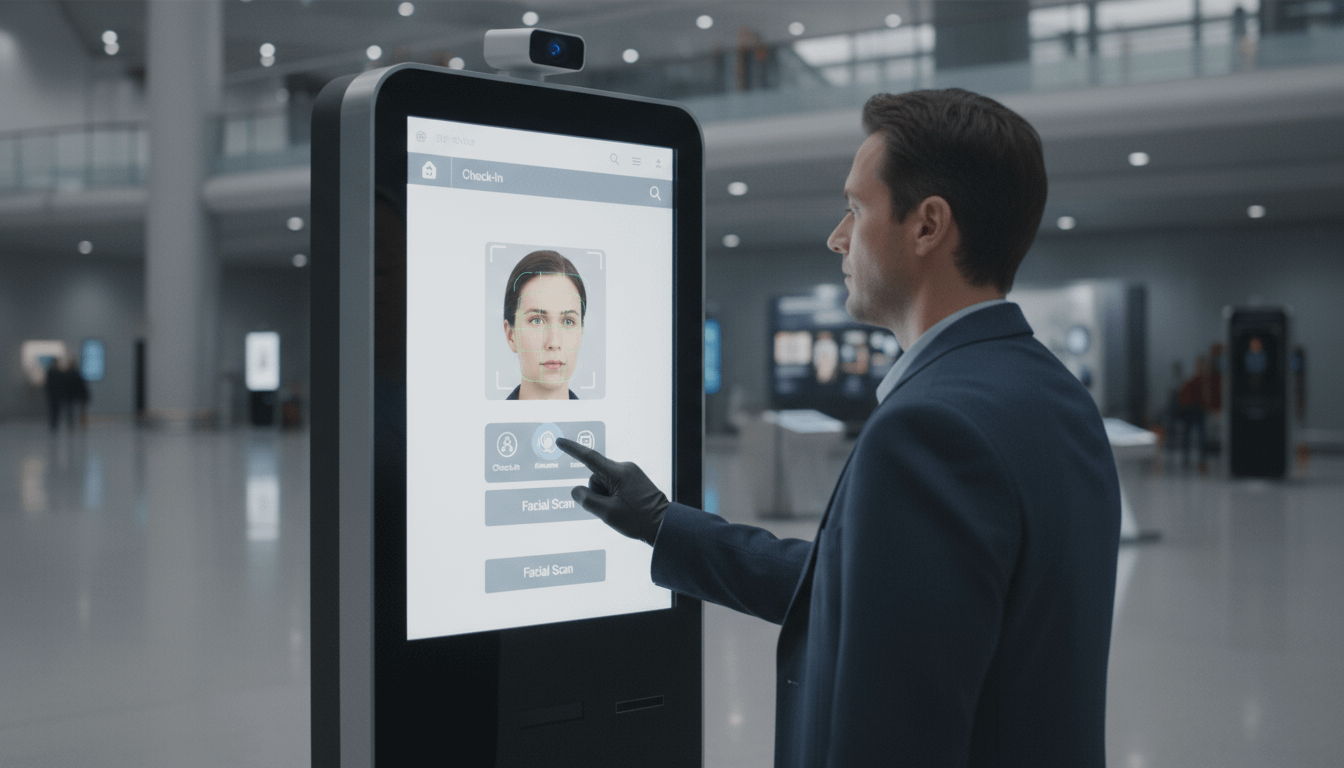
AXIS Gatepass by SMG Infosolutions supports facial recognition both at self-service kiosks and through integration with access control devices.
2. Speed Without Compromising Security
One of the persistent tensions in facility security is the trade-off between thoroughness and throughput. A highly rigorous manual check-in process creates queues. Long queues create pressure to cut corners. Cutting corners defeats the purpose of the security measure entirely.
Facial recognition eliminates this trade-off. Once a visitor has been registered and their face enrolled in the system, subsequent entries take seconds. The visitor approaches the kiosk or camera, the system verifies their identity in real time, and the gate opens. No document checks. No guard intervention. No queue.
3. Eliminating Proxy Entry and Tailgating
Two of the most common security vulnerabilities in any facility are proxy entry — where one person uses another person’s credentials to gain access — and tailgating, where an unauthorised individual follows an authorised one through a controlled entry point.
Facial recognition addresses both vulnerabilities directly. Because the system verifies the physical person rather than the credential they are carrying, proxy entry becomes effectively impossible — you cannot lend someone your face. Anti-spoofing capabilities also detect attempts to defeat the system using photographs or video playback.
4. Frictionless Re-Entry for Frequent Visitors
Many facilities receive the same vendors, auditors, consultants, and partner representatives on a regular basis. For these frequent visitors, repeating the full check-in process on every visit is an unnecessary friction that creates frustration and consumes reception resources.
With facial recognition integrated into the visitor management system, a visitor who has been registered and approved previously can re-enter without any manual intervention. The visitor feels respected rather than processed. The security team maintains complete oversight. Both outcomes are achieved simultaneously.
5. Touchless Operations for Health and Hygiene Compliance
Facial recognition is the most complete expression of touchless visitor management. There is no shared stylus on a touchscreen. No fingerprint scanner. No physical ID document being handled by multiple people. The visitor simply stands in front of the camera, and the system does the rest.
For facilities in food processing, pharmaceuticals, healthcare, and precision manufacturing — where hygiene standards are tightly regulated — this is not just a convenience. It is a compliance consideration.
6. Integration With Access Control for End-to-End Security
AXIS Gatepass integrates with access control devices, enabling organisations to tie facial verification directly to gate permissions. A visitor approved for a specific zone, for a specific time window, will find doors open when they are expected and locked when they are not — without any manual coordination from security staff.
This integration also means that if a visitor’s approval is revoked mid-visit, the system can immediately restrict their access across all connected points. Security teams receive real-time alerts, and the response can be coordinated without delay.
7. A Reliable Audit Trail for Compliance and Incident Response
A visitor management system with facial recognition creates an automatic, tamper-evident audit trail. Every entry and exit event is logged with a timestamp, a verified facial match, and the access point used. This data is stored securely and can be retrieved instantly for compliance audits, insurance claims, or incident investigations.
For facilities subject to regulatory oversight — factories under the Factories Act, pharmaceutical plants under CDSCO guidelines, or any organisation pursuing ISO certification — this kind of verifiable access record is increasingly being required as part of the compliance documentation.
8. Addressing Data Privacy Concerns Around Biometric Data
Organisations deploying facial recognition in their visitor management system need to ensure that the software meets current data protection standards. This means transparent visitor consent at the point of registration, secure encrypted storage of biometric data, strict role-based access to that data, and clear data retention and deletion policies.
SMG Infosolutions’ AXIS Gatepass is GDPR Part 11 compliant and has undergone VAPT — Vulnerability Assessment and Penetration Testing — to verify that the application meets cybersecurity standards and that biometric data is protected against unauthorised access. The platform is also ISO 27001 certified.
9. What Facial Recognition Signals About Your Organisation
A facility that uses facial recognition for visitor check-in signals something to everyone who walks through the door — clients, partners, auditors, and employees alike. It signals that the organisation takes security seriously enough to invest in proven technology. It signals that it operates to modern standards, not legacy ones.
In an Indian enterprise landscape where facility security standards are being benchmarked increasingly against global peers, organisations that lead on security technology tend to be the ones trusted with larger contracts, more sensitive engagements, and higher-value partnerships.
Is Your Facility Ready for Facial Recognition-Enabled Visitor Management?
SMG Infosolutions has been delivering facility management technology to Indian enterprises since 1992. AXIS Gatepass supports visitor management with face recognition across self-service kiosks and access control-integrated deployments, and has been implemented across 1,500+ installations in India. With a customer retention rate of over 90% and certifications in ISO 9001, ISO 27001, and VAPT compliance, it is one of the most trusted visitor management platforms in the Indian market.
Interested in seeing facial recognition-enabled visitor check-in in action at your facility? Get in touch with the SMG Infosolutions team at https://www.smginfotech.com/contact-us/ to arrange a demonstration of AXIS Gatepass.
